
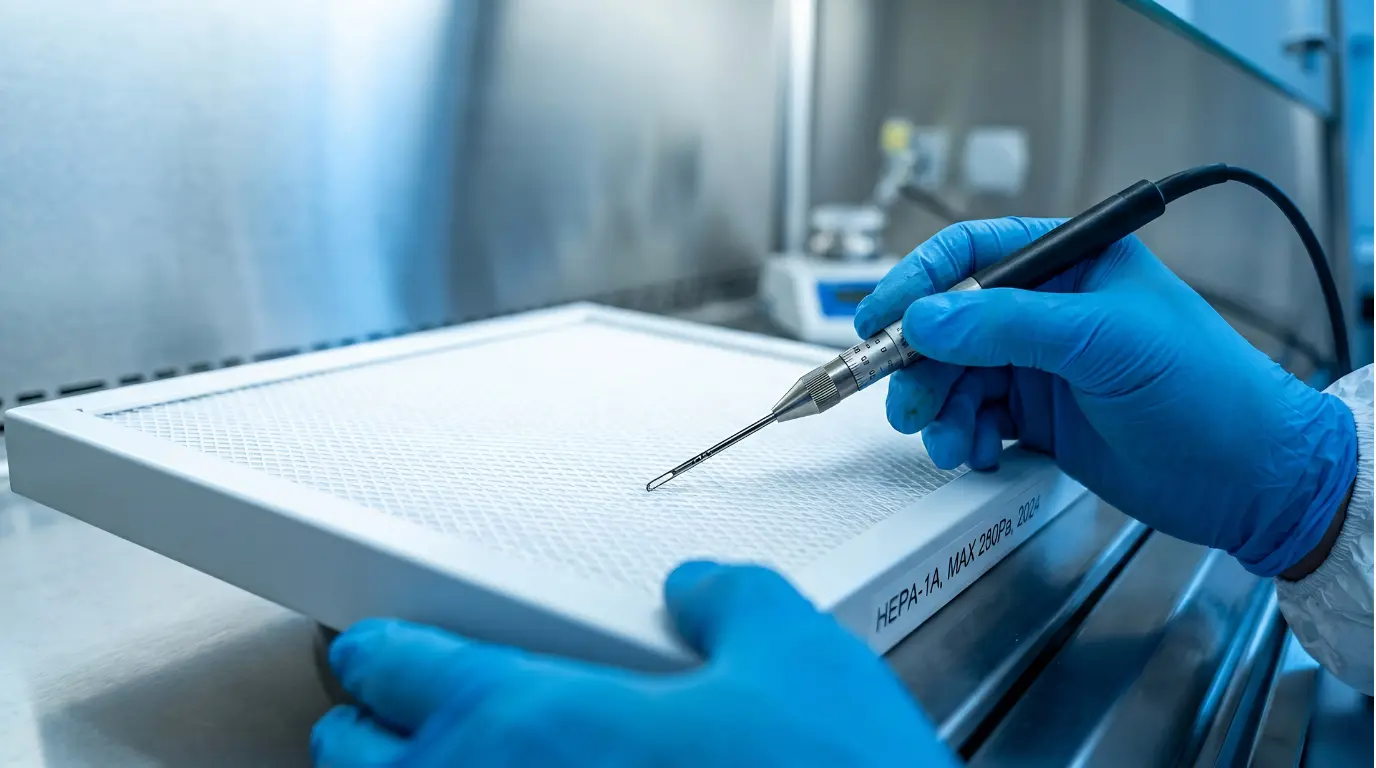
Biocontainment is built on physical barriers, negative pressure, HEPA filtration, sealed penetrations, and biological safety cabinets. But every barrier eventually needs maintenance, certification, or replacement. The decontamination that precedes that maintenance is the weakest link in the containment chain.
Biocontainment is the engineered system of physical barriers, directional airflow, and operational practices that prevent infectious agents from escaping the laboratory environment. At BSL-3, these barriers include biological safety cabinets (BSCs), HEPA-filtered exhaust systems, and negative pressure cascades. The design, construction, and commissioning of these systems are governed by detailed standards, EN 12128:1998 in Europe, BMBL 6th edition in the United States, and the WHO LBM 4th edition globally.1,2,3
What receives substantially less attention, in both the literature and in institutional practice, is what happens when these barriers need to be opened. Every BSC requires periodic certification (typically annual, per NSF/ANSI 49). Every HEPA filter has a finite service life and must eventually be replaced. Every laboratory space will, at some point, require renovation, equipment removal, or decommissioning. Before any of these activities can occur at BSL-3, the biocontainment barrier must be decontaminated to a validated standard. This decontamination step is the critical interface between the contained and uncontained world, and it is where the gap in practice is widest.
Biocontainment is only as strong as the decontamination that precedes every maintenance event. If you cannot decontaminate it, you cannot maintain it safely.
1. The Biocontainment Hierarchy: Primary, Secondary, and Tertiary Barriers
Understanding the decontamination gap requires understanding what is being decontaminated and why. Biocontainment operates through a hierarchy of barriers:
- Primary containment: biological safety cabinets, closed vessels, centrifuge safety cups, and personal protective equipment. These directly separate the operator from the biological agent.
- Secondary containment: the laboratory room itself, its sealed envelope, negative pressure differential relative to corridors, HEPA-filtered exhaust, and interlocked access controls. This prevents agent escape from the laboratory to the rest of the building.
- Tertiary containment: the building envelope and its relationship to the external environment, relevant primarily at BSL-4 and for large-scale biosafety applications.
2. Biological Safety Cabinets: The Primary Containment Decontamination Challenge
2.1 What the Standards Require
NSF/ANSI 49:2023, the standard for Class II biosafety cabinets, requires that BSCs be decontaminated before any service, repair, HEPA filter change, or relocation.4 The BMBL 6th edition specifies that formaldehyde gas or vaporized hydrogen peroxide may be used for BSC decontamination, and that the process must be performed by trained personnel following validated procedures.1
In practice, BSC decontamination with formaldehyde follows a well-established but operationally burdensome protocol: the cabinet is sealed, paraformaldehyde is heated to generate formaldehyde gas, the contact time is held for 6–12 hours, and the cabinet is then aerated. The total cycle time typically exceeds 12–24 hours.
2.2 The Gap: What Actually Happens
The gap between what the standards require and what happens in practice is significant. Survey data identify BSC decontamination as one of the most frequently cited operational challenges due to:
- Time: 12–24 hour cycles make cabinets unavailable for long periods.
- Cost: Requires specialist contractors or highly trained teams.
- Risk: Formaldehyde is a Group 1 carcinogen, posing risks to building occupants.
- Compliance documentation: Generates a heavy documentation burden.
2.3 VHP as the BSC Decontamination Solution
VHP addresses every dimension of the BSC decontamination gap. Cycle times for BSC-scale volumes are significantly shorter (3-5 hours). Post-cycle residues are water vapour and oxygen, leaving no toxic residues. The operator exposure profile is much safer, with no carcinogenicity and a higher PEL (1.0 ppm).6,7
The Delox Box device is specifically designed for this application, covering the full range of Class II BSC internal volumes with the solid-state DeloxHP formulation.
3. Room-Level Decontamination: The Secondary Containment Challenge
3.1 When Room-Level Decontamination Is Required
At BSL-3, room-level gaseous decontamination is required before renovation, HEPA filter replacement, decommissioning, or after a significant spill. Each of these events requires that the entire secondary containment volume be decontaminated to permit safe entry by unprotected personnel.1
3.2 The Validation Requirement
Both the BMBL and the WHO LBM require that room-level decontamination be validated using biological indicators (typically Geobacillus stearothermophilus) placed in worst-case locations. VHP has a substantial advantage in room-level validation because of its uniform distribution and lack of toxic residues.1,2,8
4. The BSL-2 to BSL-3 Upgrade: Decontamination as a Design Criterion
Upgrading a BSL-2 laboratory to BSL-3 requires integrating a validated decontamination capability. This should be considered at the design stage, including VHP distribution points, biological indicator placement, and integration with building management systems. The DeloxHP solid-state system simplifies this integration as it doesn’t require plumbed liquid supply or steam.
5. Comparison: Formaldehyde vs. VHP for Biocontainment Decontamination
| Parameter | Formaldehyde | VHP / DeloxHP |
|---|---|---|
| IARC carcinogenicity | Group 1, nasopharyngeal cancer, myeloid leukaemia | Not classified |
| OSHA PEL | 0.75 ppm TWA | 1.0 ppm TWA |
| BSC decontamination cycle time | 12–24 hours (including aeration) | 3–5 hours (including aeration) |
| Post-cycle residues | Paraformaldehyde (requires wipe-down + neutralisation) | H₂O + O₂ only (no cleanup required) |
| Humidity requirement | 60–80% RH (critical for efficacy) | Lower RH desired to minimize condensation |
| Temperature requirement | >18°C (below 9°C: unreliable) | Operates at ambient temperature |
| Mandatory medical surveillance | Yes (OSHA 1910.1048) | Not required |
| Validation framework | Institution-specific SOPs | ISO 22441:2022 (FDA-recognised) |
| Regulatory trajectory | Tightening, CMD 2019/983; REACH 2026 | Favourable, FDA Cat. A; EU GMP Annex 1 |
6. Conclusion
Biocontainment depends on the ability to decontaminate barriers safely and quickly. The gap in practice is widest at the points where the containment barrier is opened. Vaporized hydrogen peroxide, delivered via the DeloxHP solid-state formulation, closes this gap by delivering validated sporicidal decontamination in operationally compatible cycle times without the risks of formaldehyde.
Frequently Asked Questions
How often must a biological safety cabinet be decontaminated?
NSF/ANSI 49:2023 requires decontamination before any service, repair, HEPA filter change, relocation, or annual certification. At minimum, this occurs once per year.4
Can VHP replace formaldehyde for BSC decontamination?
Yes. The BMBL 6th edition explicitly recognises VHP as an established alternative. It achieves equivalent efficacy in significantly shorter cycle times without carcinogenic risk.1,7,8
What is required for BSL-3 room-level decontamination?
BSL-3 laboratories must have a validated gaseous decontamination capability for the entire space, to be used before renovations, maintenance, or after significant spills. Validation using biological indicators is mandatory.1
Is room-level decontamination required at BSL-2?
It is not a standard requirement but may be appropriate for specific events like decommissioning or responding to high-consequence spills, based on institutional risk assessment.
References
- Meechan PJ, Wilson DE, editors. Biosafety in microbiological and biomedical laboratories. 6th ed. CDC/NIH; 2020.
- World Health Organization. Laboratory biosafety manual. 4th ed. WHO; 2020.
- EN 12128:1998, Biotechnology: containment levels of microbiology laboratories.
- NSF/ANSI 49:2024, Biosafety cabinetry: design, construction, performance, and field certification.
- Ngabo D, et al. Cabinet decontamination using formaldehyde. Appl Biosaf. 2017.
- IARC monographs on the evaluation of carcinogenic risks to humans. Volume 100F.
- Ayub A, et al. Studies on VHP efficacy and safety.
- ISO 22441:2022, Sterilization of health care products — VHP.

